Dressing Judeans and Christians in Antiquity by Batten Alicia J. Daniel-Hughes Carly Upson-Saia Kristi
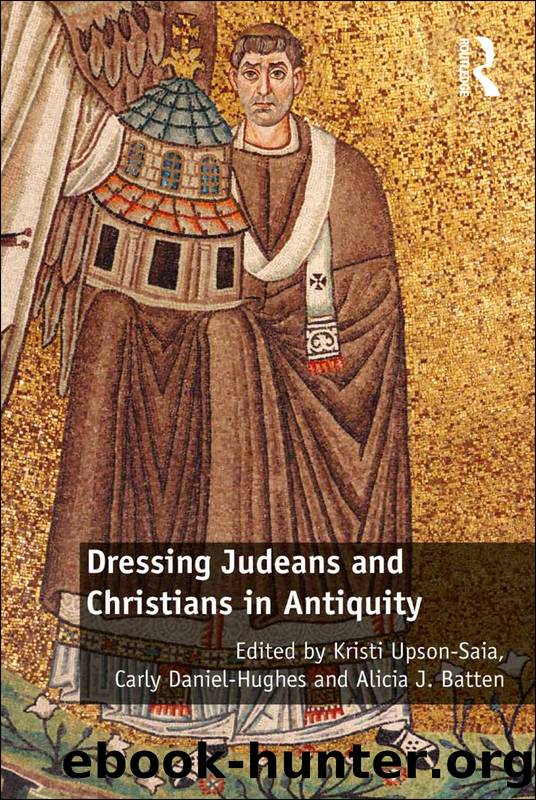
Author:Batten, Alicia J.,Daniel-Hughes, Carly,Upson-Saia, Kristi
Language: eng
Format: epub
Publisher: Taylor & Francis (CAM)
Published: 2014-01-15T00:00:00+00:00
Clothing as an Indicator of Transformation
Aseneth wears a total of four outfits that punctuate her transformation: her original finery, her mourning clothes, and two outfits demanded by the heavenly visitor, the first with the âtwin girdleâ and the second with the ârobe like lightning.â Aseneth is seen by other humans at only two times during the process: after the first outfit and just before the final outfit. These human onlookers act as witnesses to her transformation. The first outfit is seen by her parents, by Joseph, and presumably by the rest of her household, as well as Asenethâs virgin attendants. After the visitor returns to heaven, Asenethâs fallen face is seen by her foster father, who likewise witnesses her transformed and radiant state once she dons that final ensemble with the robe that is âlike lightning.â
Scholars who have focused on Asenethâs clothing changes have framed their analysis either in terms of biblical parallels or initiation rituals. Randall Chesnuttâs contribution falls under the latter category but he ignores the final change of clothing into the robe like lightning since he sees it as âexplicitly related to Asenethâs marriage to Joseph rather than her conversion.â17 Generally, Chesnutt views the mourning clothes as symbolic of Asenethâs death and he therefore associates them with the death-to-life imagery that he argues symbolizes her conversion.18 However, it seems unlikely to me that Aseneth remained in her final outfit for the whole remainder of the day, overnight, and into the next, since her wedding is not to occur until the following day (20.8). Rather, the final description of clothing is significant for Asenethâs transformation rather than for her wedding; her wedding to Joseph is clearly chronologically and sartorially distinct from her transformative experience.19
Kraemerâs analysis is closer to the mark, in my opinion; she finds affinities between Asenethâs transformation and mystical transformations in the hekhalot traditions. Indeed, there are similarities between Joseph and Aseneth and the Enoch traditions: 2 Enoch 22.8â10 describes brilliant and radiant clothing, as does 3 Enoch 12; likewise, the various traditions share the imagery of glowing splendor attained by those transformed in this way.20 Kraemer acknowledges some important deviations, however, such as the absence of anointing in Joseph and Aseneth and the fact that Aseneth changes into special attire twice at the visitorâs command, not once.21 Regardless, the similarities are strong enough for Kraemer to conclude that Asenethâs experience with the heavenly man represents her transformation into some kind of angelic being, as evidenced by her radiant face and eyes.22
Clearly, the imagery used to describe both the heavenly visitor and Aseneth shares affinities with this tradition; but the description of a heroine in these terms should also be examined in the context of other novels from the Hellenistic era, which describe heroines in similar terms and which, as I discuss below, have well-established generic links with our text. Thus, while I agree that Asenethâs clothing could reflect the imagery used in heavenly visits in biblical texts, I would also suggest that a more complete understanding of her clothing and its functions can be understood in light of these other novels.
Download
This site does not store any files on its server. We only index and link to content provided by other sites. Please contact the content providers to delete copyright contents if any and email us, we'll remove relevant links or contents immediately.
Aircraft Design of WWII: A Sketchbook by Lockheed Aircraft Corporation(32275)
The Great Music City by Andrea Baker(31907)
Call Me by Your Name by André Aciman(20478)
The Secret History by Donna Tartt(19010)
The Art of Boudoir Photography: How to Create Stunning Photographs of Women by Christa Meola(18606)
Shoot Sexy by Ryan Armbrust(17716)
Plagued by Fire by Paul Hendrickson(17395)
Portrait Mastery in Black & White: Learn the Signature Style of a Legendary Photographer by Tim Kelly(16996)
Adobe Camera Raw For Digital Photographers Only by Rob Sheppard(16961)
Photographically Speaking: A Deeper Look at Creating Stronger Images (Eva Spring's Library) by David duChemin(16673)
Ready Player One by Cline Ernest(14625)
Pimp by Iceberg Slim(14472)
Bombshells: Glamour Girls of a Lifetime by Sullivan Steve(14042)
The Goal (Off-Campus #4) by Elle Kennedy(13644)
Art Nude Photography Explained: How to Photograph and Understand Great Art Nude Images by Simon Walden(13025)
Kathy Andrews Collection by Kathy Andrews(11798)
The Priory of the Orange Tree by Samantha Shannon(9053)
The remains of the day by Kazuo Ishiguro(8959)
Thirteen Reasons Why by Jay Asher(8878)
